Why Corporate English Training Fails: 5 Reasons Employees Still Don't Speak Up

Many HR teams know this story. The company pays for corporate English training. Attendance looks fine, and employees say the course was good. A few months later, nobody speaks up in global meetings. When leadership asks about results, it's hard to say how much anyone improved.
This usually doesn't mean HR didn't try, employees didn't care, or the course was bad. More often, the program was missing a few key pieces from the start.
This article covers five common reasons English training for employees falls short. For each one, you'll find questions to check your own program and ways to fix it. Use it to plan your next training cycle or to review why the last one didn't deliver.
Quick Answer: Why Doesn't Corporate English Training Work?
When corporate English training doesn't work, the course itself is rarely the problem. Five issues come up most often. Employees only practice during class. One course tries to fit every level. Class times clash with work schedules. Nobody runs pre- and post-tests to show progress. And HR has no tool to track real usage. These problems tend to show up together, and each one cuts into the return on your training budget.
Reason 1: Employees Get Too Little Practice and Forget What They Learned
🙋🏻♀️ Why do employees forget what they learned in English class?
Language learning doesn't work like other training. Someone who takes a finance course may remember the ideas for years. Speaking skills are different. Without practice after class, they fade within weeks.
Learning a language takes a lot of steady listening and speaking. A few classes a month won't get there. In many global companies, employees outside English-speaking offices barely use English during the workday. They only speak it when the next class comes around. That pace makes it hard to build real speaking ability.
Research shows the same gap. In a Pearson survey of more than 5,000 people who use English as a second or additional language, 85% said English is critical for work. Only about a quarter felt confident in all four skills at work: reading, listening, writing, and speaking.
So corporate English training can't stop at "took the class" or "memorized the words." What counts is whether employees can listen, speak up, and respond in real work situations.
What HR Can Check
In your current program, how many times a week does each employee speak English?
Outside of class, do employees have any way to practice on their own?
Do you know how many minutes each employee really practices per month?
How to Fix It
Most speaking skill is built outside the classroom. Consider adding a tool that lets employees practice anytime, with no class to book.
With Toko, for example, employees can start an AI conversation whenever and wherever they want. There's nothing to book and no limit on how often they practice. They might run through a conversation on the commute or do a few speaking tasks at lunch. Fifteen to 20 minutes a day adds up to far more speaking time than one two-hour class a month. The goal is to make practice a daily habit instead of an event to attend.
 |  |
|---|
Toko lets employees start an AI conversation, a news topic, or a bundle lesson whenever it suits them, so speaking practice fits into daily work and life.
Reason 2: Employees Are at Different Levels but Take the Same Course
🙋🏻♀️ What happens when employees at different English levels share one class?
In one department, one person may be at a B2 level while another barely dares to speak. Put them in the same course, and the stronger employees find it too easy. The weaker ones can't keep up. Both groups end up feeling the class isn't much use.
This is easy to see in manufacturing and engineering. Engineers need to discuss technical issues and read specs in English. Sales teams need to host visitors and handle business calls smoothly. HR staff often use English with vendors or when they report to managers overseas. In one shared class, none of them learns what they need most.
Companies need English across many roles, and a single course can't cover such different needs. For a step-by-step approach, see our 4-step corporate English training plan for mixed-level teams.
What HR Can Check
Before the last program, did you find out the starting level of each department and employee?
Was the content designed for different roles and levels?
After the program, how did feedback differ between stronger and weaker employees?
How to Fix It
Before training starts, run a simple level assessment to learn where each employee stands. Then assign content by level or by role.
Toko has two features for this. With custom scenarios, a company can build practice around its own work situations, such as talking through factory equipment issues, giving a technical briefing, or joining a global video call. Workplace English tutor bundles cover business situations from beginner to advanced, so employees can pick the practice that fits their level and role.
 |  |
|---|
With Toko's custom scenarios and Workplace English tutor bundles, engineers, sales staff, and managers learn on one platform. Each person focuses on the English they need for their own job, and nobody has to squeeze into the same class.
Reason 3: Class Schedules Are Too Rigid for Employees to Keep Up
🙋🏻♀️ Why do employees drop out of English training?
For most employees, English class is one more thing on top of work. Say the class runs every Wednesday night, or lessons must be booked in advance. Engineers on factory shifts, sales reps who travel often, and project managers who work late for clients in other time zones may not be able to attend regularly.
HR teams often tell us that rigid schedules are a top reason employees quit partway through. Even a motivated employee can miss half the month's classes once shifts get messy.
Learning English takes time, and real progress comes from steady practice. Some companies expect a one-time course to deliver big results, and that almost never happens. How steady and flexible a program is often matters more than what's in the course.
What HR Can Check
What is the real attendance rate for each training cycle?
What do employees say about the schedule? How many miss class because of shift conflicts?
Does attendance differ much between departments, such as manufacturing, sales, and admin?
How to Fix It
Alongside fixed classes, add a tool that lets employees choose when to practice. Training should follow the pace of work, and work shouldn't have to make room for training.
Toko is built for this. It's available 24/7, with no lessons to book. Employees can open the app on the morning commute, after a factory shift, or on a business trip. They can practice one conversation and stop, so a busy week no longer derails the whole learning plan. Fixed classes still have a place. Toko fills the gap outside the classroom, so the program doesn't depend on one class a week.
Reason 4: No Pre- and Post-Test Data, So Progress Can't Be Measured
🙋🏻♀️ How can HR prove corporate English training ROI to leadership?
This may be HR's biggest headache. A manager asks, "After all these classes, has anyone's English improved?" You might only be able to say "employees liked it" or "attendance was 80%." Hard numbers are much harder to give.
Learning outcomes are the change in an employee's ability before and after training. Without data behind them, it's tough to report up and tough to win budget for the next cycle. And if nobody ran a pre-test, there's no baseline to compare against.
Employers are paying more attention to this. For its 2026 TOEIC Global English Skills Report, ETS surveyed more than 1,300 HR decision-makers in 17 countries. Of those, 92% said English skills matter more today than they did five years ago. And 84% expect organizations in their country to invest in English assessment and education within five years. Valuing English is one thing. Showing numbers that prove training worked is another, and that's what keeps the budget coming.
What HR Can Check
Before the last program began, did employees take a baseline assessment (a pre-test)?
After it ended, did you measure their ability the same way (a post-test)?
What numbers are in the training report you can show leadership today?
How to Fix It
At the start of each program, run a baseline test and record each employee's starting point. At the end, run another test with the same standard. The gap between the two scores shows how much each person improved. A learning tool with a built-in assessment makes this easier and more objective.
Take a Taiwan-based semiconductor company that works with Toko. After it rolled out AI speaking practice, more than 90% of employees showed measurable improvement between the pre- and post-assessments. Employees practiced an average of 180 minutes a month. Numbers like these give HR solid proof for leadership and a strong case for renewal.
Reason 5: HR Can't See Whether Employees Are Really Using the Tool
🙋🏻♀️ How can HR track employee English learning progress?
Even after the company buys a tool and sets up classes, many HR teams still don't know if employees are using it. An active account doesn't mean someone logs in. Logging in doesn't mean real practice. If HR has to ask each person or rely on self-reported hours, the data is shaky and takes a lot of time to collect.
The problem grows with more accounts and more departments. Managing 20 accounts and managing 200 are very different jobs.
An HR admin dashboard lets HR see every employee's usage data in one place. Whether a tool has one often decides if the program can last.
What HR Can Check
Does your current tool give HR a usage report?
Do you know how long each employee practiced last month?
If leadership asked for the participation rate today, could you pull the number right away?
How to Fix It
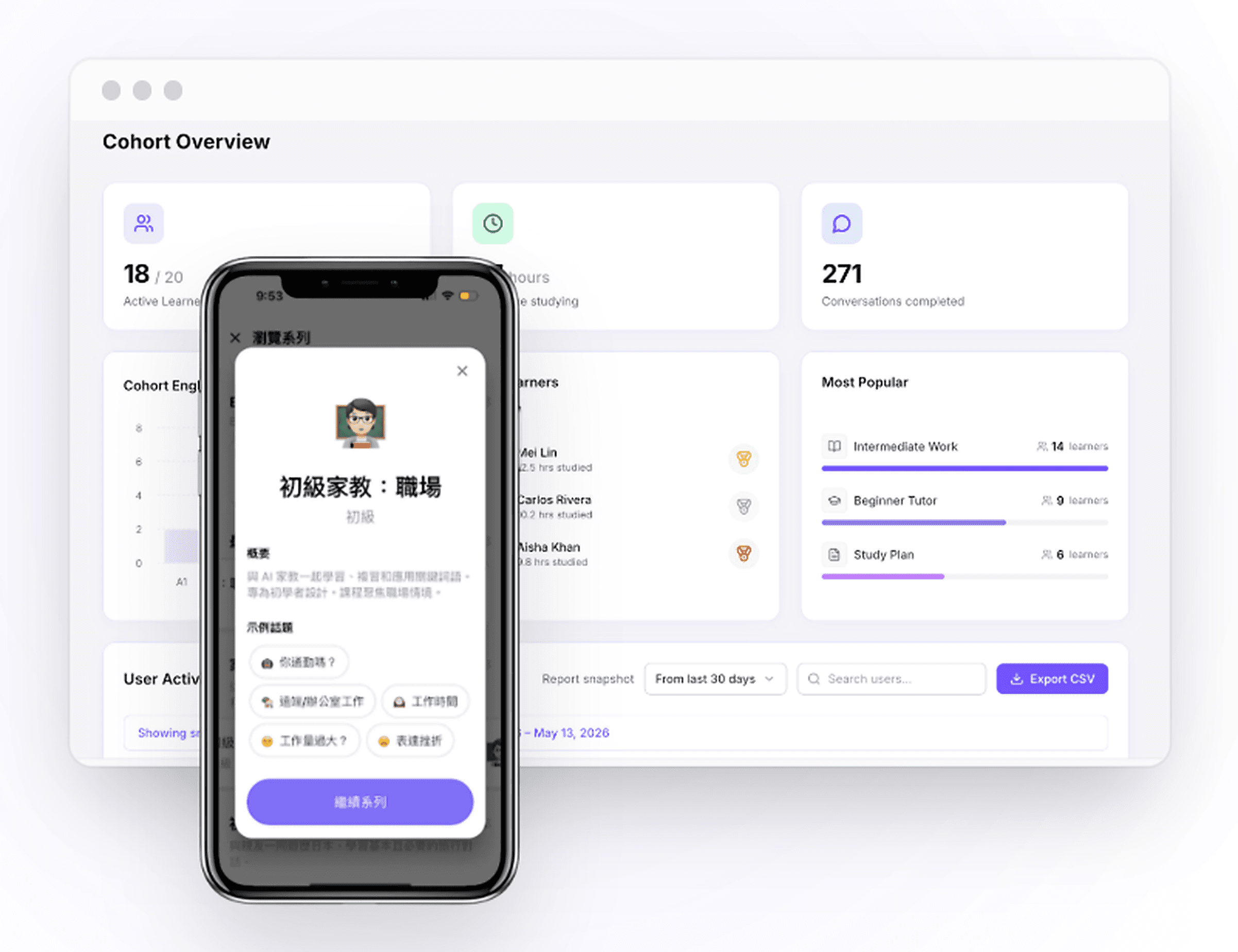
When you compare corporate English training tools, make an HR admin dashboard a must-have. Check that the tool shows each employee's learning hours, login frequency, and progress, and that it can export reports. With this data, HR can track usage, spot employees with low participation, and step in early.
Toko's plans for organizations include an HR admin dashboard. You can see overall participation without asking employees one by one, and it's easy to prepare regular reports for managers or executives.

The 5 Reasons at a Glance
Problem | What HR can check first | How to fix it |
|---|---|---|
Too little practice | Do employees only speak English in class? | Add speaking practice after class and make it a daily habit |
Mixed levels | Is the same class too easy for some and too hard for others? | Assess levels first, then assign content by level and role |
Rigid schedules | Do employees often miss class for shifts, travel, or work conflicts? | Add a tool for anytime practice to ease scheduling limits |
No pre- and post-tests | Can HR only report attendance or satisfaction? | Assess before and after training and track progress with data |
No usage tracking | Once accounts are active, does HR know who practices and for how long? | Choose a tool with an HR dashboard and review the data regularly |
If you're planning your next round of corporate English training, 👉 see how Toko combines AI speaking practice, pre- and post-assessments, and an HR admin dashboard.
What to Do After Reviewing These 5 Reasons
🙋🏻♀️ Should companies choose an AI English learning app or live classes for employee training?
Some of these problems can be fixed inside your current program. You can add pre- and post-tests or regroup classes by level. Others are harder: low practice frequency, rigid schedules, and no usage data. Classroom courses alone can't solve those, because they sit outside what a class can cover.
Here's how AI English learning tools compare with traditional live classes on these pain points:
What to compare | Traditional live classes | AI English learning app (such as Toko) |
|---|---|---|
Practice frequency | Fixed classes, limited sessions | ✅ Practice any time, every day |
Scheduling | Fixed time slots, booked in advance | ✅ Available 24/7, no booking |
Practice content | One syllabus, hard to customize | ✅ Personalized by level and work scenario |
Feedback | Only during class | ✅ Grammar and pronunciation feedback available in every session |
HR tracking | Records compiled by hand | ✅ Learning data in one dashboard |
Live instructors still matter. AI tools add more practice, save HR admin time, and make results easier to measure.
Want to see how Toko can help with these problems? 👉 Book a free demo, and we'll walk you through the plan that fits your company's needs.
FAQ: Corporate English Training for Employees
Q1: How Long Does Corporate English Training Take to Show Results?
No single answer fits every company, but a few principles help. Language learning takes steady effort over time. A one-time short course rarely produces lasting results. If employees get regular practice each week, in class or on their own, clear progress often shows in three to six months. The total number of class hours matters less than how regular the practice is.
Q2: How Can HR Tell Whether Employees' English Is Improving?
The most direct way is a pre- and post-test. Assess levels before training starts, then assess again at the end with the same standard, and compare the scores. A learning tool with a built-in assessment can often create progress reports for you. Beyond scores, watch how employees perform in real work, such as global meetings and English emails.
Q3: Employees Are Afraid to Speak English. How Should Training Be Designed?
This is one of the most common barriers in workplace English training. Employees need a safe way to start speaking and more contact with spoken English. Low pressure is one strength of AI speaking practice. There's no fear of being judged. Employees can practice again and again with nobody watching, so they're more willing to try full sentences. Toko is designed around relaxed, no-stress learning, which helps employees move from fearing mistakes to speaking up.
Q4: Can Employees at Very Different Levels Use the Same English Training Platform?
Yes, with the right tool. A good corporate English learning platform lets each employee start from their own level instead of giving everyone the same material. Toko offers personalized pacing, with content for different levels and workplace situations. Engineers and sales staff can use the same platform and each practice the English closest to their own work.
Q5: How Much Should Employees Practice English Each Month?
There's no fixed rule. For building speaking skills, 120 to 180 minutes of real speaking practice a month is a useful range. At one Taiwan-based semiconductor company that adopted an AI English speaking tool, employees averaged 180 minutes of practice a month. Over time, more than 90% of them showed measurable improvement between pre- and post-assessments.
Q6: How Much Do Corporate English Learning Tools Cost?
Most AI English learning platforms for companies charge per user per year, and the price varies with headcount. In general, the yearly cost per person is much lower than one-on-one tutoring or in-person classes. Toko offers flexible volume plans based on company needs. 👉 See Toko's plans for organizations to get a quote for your team size and learn about the HR admin dashboard, progress tracking, and customer support.
Q7: Which Metrics Can HR Use to Measure Corporate English Training ROI?
ROI (return on investment) asks whether the company sees real results from its English training spend. HR can look at account activation rate, monthly practice time, participation rate, changes between pre- and post-test scores, and feedback from managers or employees on real work performance.
With Toko, employees can take an English speaking assessment before they start, which sets the baseline. After a period of AI conversation practice, they retake it at regular intervals. HR can then see score changes in the dashboard, track whether speaking has improved, and report results to leadership more easily.
Q8: Can AI English Learning Tools Replace Human Teachers?
An AI English learning app is best at what traditional classes struggle to cover: frequent practice, feedback on demand, flexible use, and data tracking. Human teachers are better at in-depth guidance, tailored teaching, and adjusting learning strategies. For companies, the two can work together. Live classes set the direction, and AI tools keep employees practicing after class.
Want to See How Toko Solves These Problems for Your Team?
If you read this and thought, "our company has all five problems," book a 👉 Toko demo for organizations. We'll recommend a plan based on your company's size, department needs, and current training setup. That includes the HR admin dashboard, progress reports, and flexible practice.
👉 Book Your Free Demo
Sources
Pearson: English skills have life-changing impact, published March 12, 2024
ETS: TOEIC Global English Skills Report launch, published March 9, 2026
Toko: Employees at Different English Levels? A 4-Step Corporate English Training Plan
About the Author
 | Connie Lin leads market strategy, product localization, and content marketing for Taiwan. Her background is in Chinese-English translation, localization strategy, and education marketing. She has worked on product QA, B2B content, and user communication for years, so she knows what learners and corporate training teams in Taiwan need. She also keeps a close eye on AI English learning tools and market trends. |