Employees at Different English Levels? A 4-Step Corporate English Training Plan
Jul 15, 2026

Before a corporate English class starts, everyone says they want to learn English. Once the class begins, it's a different story. A senior engineer with a TOEIC score of 800 finds the content too easy and stops showing up after two sessions. An admin colleague who has barely spoken English can't keep up and gets more frustrated with every class. HR sits in the middle, and no adjustment seems to work for both sides.
Corporate English training often runs into a very practical problem: one group of employees, many different English levels and different job needs. Some are still building basic vocabulary and sentence patterns. Others can already run meetings with overseas clients. Put everyone in the same curriculum, and the first group falls behind while the second group feels like it's wasting their time.
This article walks through a 4 step plan HR can put into action right away:
1) Assess starting levels with an English test.
2) Set goals based on level and job needs.
3) Choose between classes, groups, or personalized learning.
4) Track progress with pre- and post-tests (plus usage data).
How should HR handle a wide range of English levels?When employee English levels vary a lot, HR can follow these 4 steps:
In short: test first, set goals, pick a learning path, then track results. |
Why One-Size-Fits-All Training Fails Everyone
🙋🏻♀️ Employee English levels vary a lot. How should corporate English training be arranged?
Language classes are different from other corporate training. A cybersecurity or compliance course works fine as one course for the whole company, because everyone starts from a similar point. English is not like that. People differ widely in how they learned English, how often they use it at work, and how willing they are to speak up.
In Toko's past interviews with corporate clients, an HR manager at a financial company said the employees who needed training ranged from A1 to B1, with most at A1. An HR manager at an IC design company saw the same thing among engineers: beginners and intermediate to advanced learners on the same team.
Level is only the first dimension. The second is job requirements. Engineers need technical discussions and spec reading. Sales teams need to host visitors and handle calls. Retail staff need a different set of service English. Stack the two dimensions together, and one curriculum for the whole company can hardly teach anyone what they actually need.
Keep in mind: an English level only tells you where an employee stands today. Job requirements decide where the company should put its training budget. HR can look at both dimensions together, then decide who needs training first and how far they need to go.
Compared to the job's English bar | How often English is used at work | Suggested arrangement |
|---|---|---|
Below the requirement | High | Train first. Build the basics, then practice the most common work scenarios |
Close to or at the requirement | High | Focus on meetings, presentations, and client communication practice |
Below the requirement | Low | Start with a personalized tool and check in regularly. Group classes may not be needed yet |
At the requirement | Low | Keep up speaking frequency with advanced content or optional courses |
Step 1: Assess Employee English Levels with a Consistent Test
🙋🏻♀️ How should HR test employee English levels before planning corporate training?
Before arranging corporate English training, confirm each employee's starting point in a consistent way. Relying on managers' impressions or a self-rated "beginner, intermediate, advanced" survey leads to inconsistent standards. Many companies skip this step and sort people by impression or self-ratings. The problem with self-ratings is that no two people use the same yardstick. Someone with a TOEIC 750 may still call themselves a beginner, while others overestimate their real speaking ability at work.
Which test to choose depends on what the company will do with the results. For hiring or promotion decisions, use a recognized standardized test. If the training focuses on speaking, the test itself must include speaking. If the company already has employees' recent TOEIC or other standardized test scores, use them for a first pass, then assess speaking separately.
A reliable approach is to use the CEFR (Common European Framework of Reference for Languages) as the single standard for the whole company. The CEFR divides language ability into six levels and describes what a person can actually do in English. It is recognized worldwide, so results from different tests can be mapped to the same scale.
CEFR level | Label | What it roughly means at work |
|---|---|---|
A1 | Beginner | Greetings and simple self-introductions |
A2 | Elementary | Handle short everyday conversations and read simple emails |
B1 | Intermediate | Join discussions on familiar topics and write work emails |
B2 | Upper intermediate | Share opinions in meetings and communicate with clients fairly smoothly |
C1 | Advanced | Lead meetings and handle complex communication like negotiations |
C2 | Proficient | Understand and handle highly complex communication with precision |
If employees have TOEIC scores on hand, use the official mapping for a rough conversion:
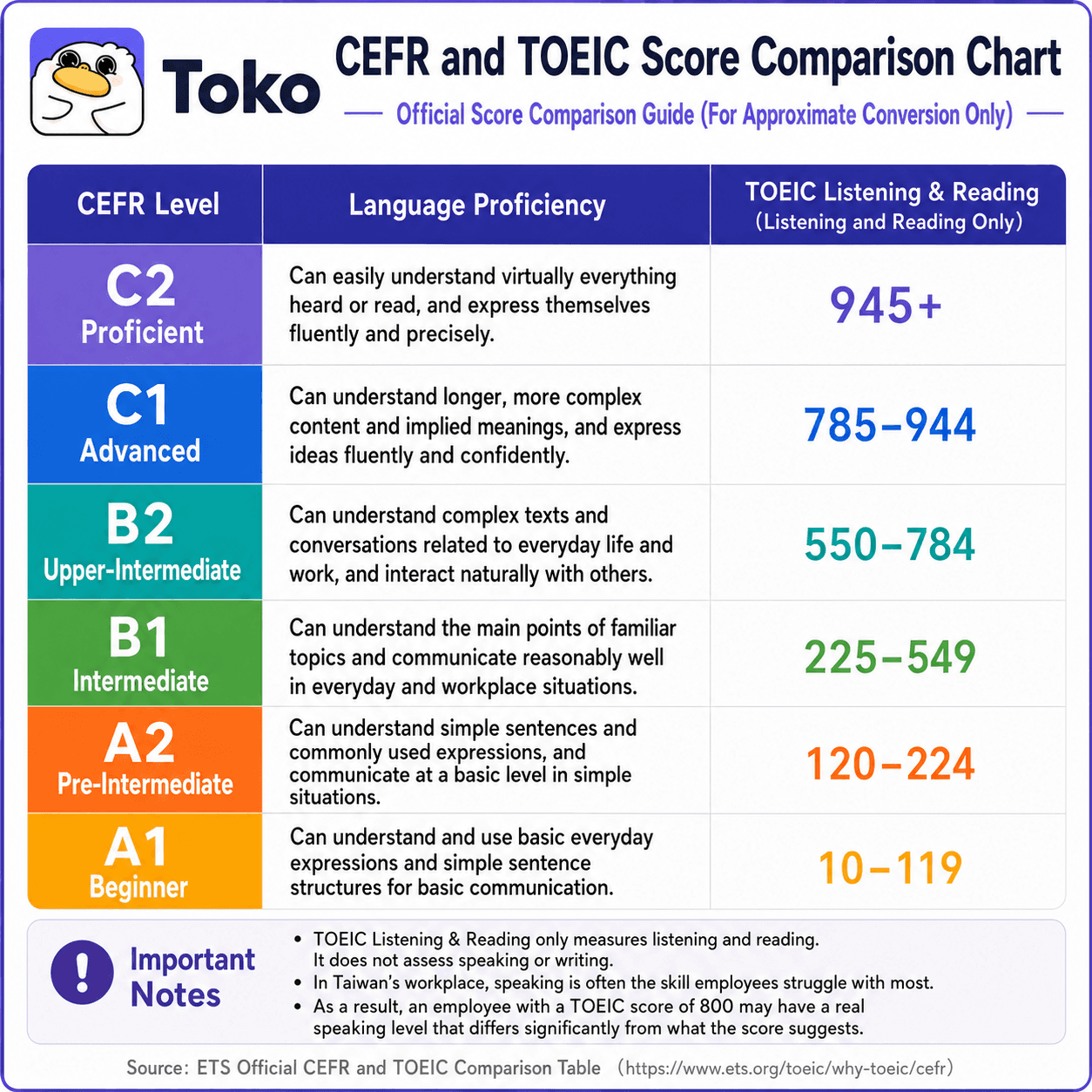
Evaluating English speaking skills is easier than ever. For example, Toko includes a built-in English speaking assessment that helps measure speaking proficiency. Employees take it from the Profile page, and it takes about five minutes. When it's done, the AI gives a CEFR speaking level, along with details like speaking speed and the number of words used, plus a replay of the full test conversation. For HR, this means employees complete it right in the app. There are no group testing sessions to schedule, and every leveling decision afterward has data behind it.
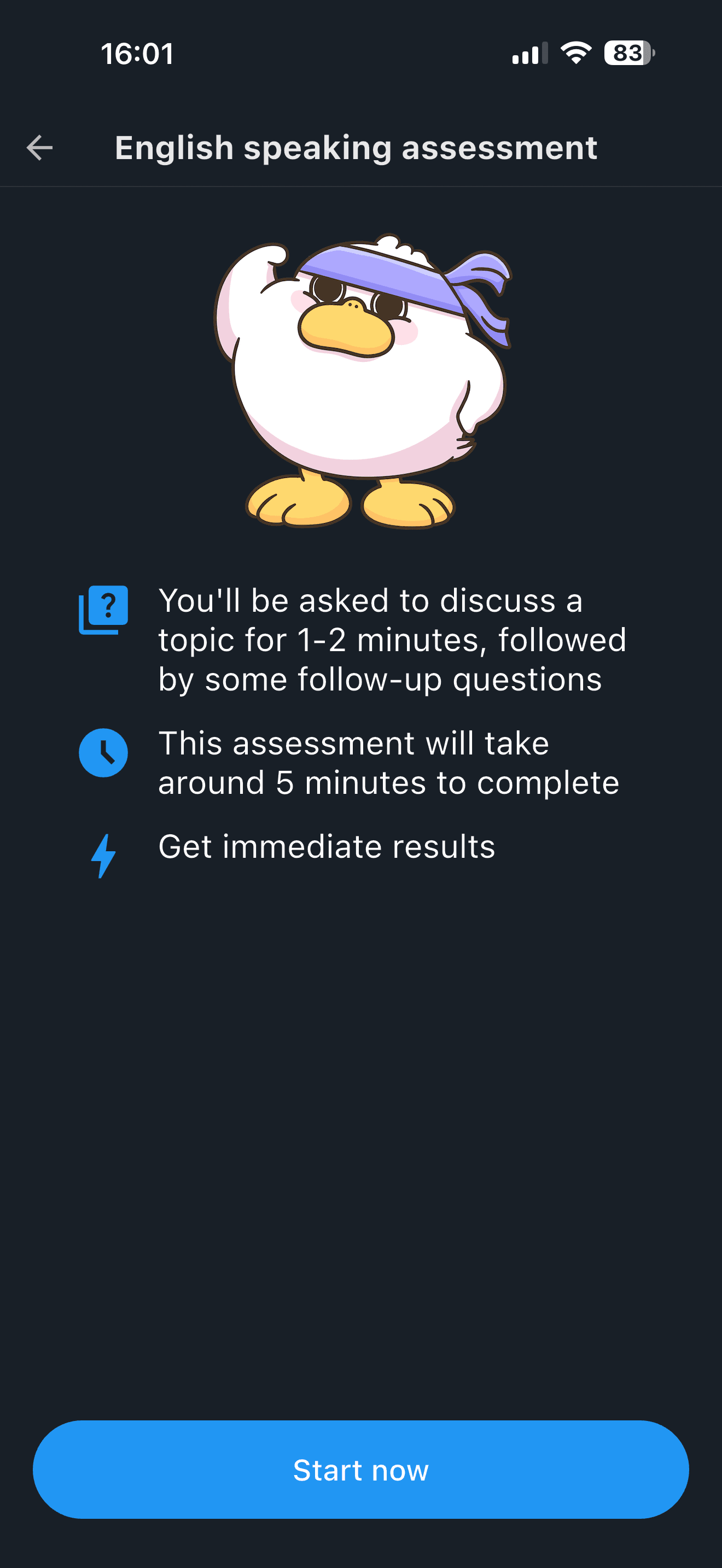 | 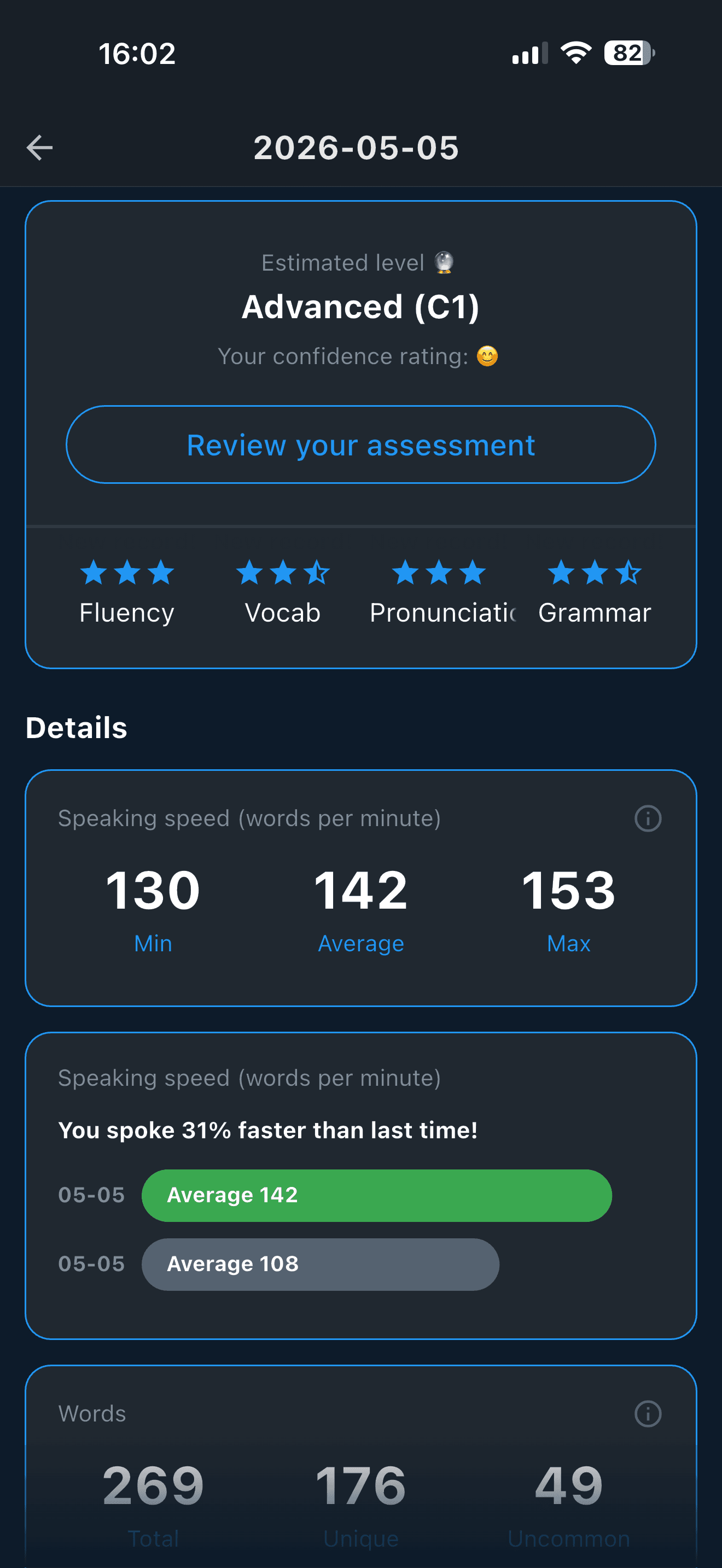 |
|---|---|
HR can ask employees to retake the assessment at regular intervals | Results let HR see how much each employee has improved |
Step 2: Set Different Learning Goals for Each Level
🙋🏻♀️ How should HR set level-based learning goals when employees are at different levels?
After assessing starting points, the next common mistake is giving everyone the same goal, like "improve business English." That goal is too far away for an A2 learner and too vague for a B2 learner. Goals should follow the level:
Current level | Focus for this cycle | Work tasks to complete after training |
|---|---|---|
A1-A2 | Basic sentence patterns and speaking confidence | Greet visitors in simple English, give a self-introduction, reply to short emails |
B1 | Explain familiar work clearly | Report progress in meetings and explain a problem, its cause, and next steps |
B2 | Fluency and quick responses | State opinions, handle follow-up questions, and confirm meeting conclusions |
C1 and above | Precision, natural phrasing, and tone | Lead meetings or negotiations, adjusting wording and politeness to the audience |
Two practical reminders. For lower-level employees, keep goals small enough to actually achieve. Early wins matter more than fast progress, or they will give up quickly. Higher-level employees are the opposite. What they usually lack is more natural phrasing and more complex scenarios. Content that is too easy just tells them not to show up.
Step 3: Choose How to Organize the Training
🙋🏻♀️ What can HR do when the team is small and levels are spread out?
Once you know each person's level and goal, then comes the question of format. There are three common approaches, each suited to different company sizes and budgets:
Level-based classes | Role-based groups | AI English learning app | |
|---|---|---|---|
How it works | Beginner, intermediate, and advanced classes | An engineer class, a sales class, and so on | Everyone learns on one platform, each at their own pace |
Best company size | Large companies that can fill a class at every level | Companies with enough people in a single role | ✅ Any size |
Cost | High (more classes mean more instructor hours) | Medium | ✅ Low |
Level fit | Gaps remain within each class | Even bigger gaps within each class | ✅ Everyone starts from their own level |
Scheduling | Hard (every class needs its own time slot) | Hard | ✅ No booking needed |
Level-based classes are the most intuitive fix, and they work at large companies. But if the training list has only 10 to 30 people spread from A1 to C1, splitting them into three small classes is usually not realistic. These companies can mix approaches: cover shared topics like meetings and workplace scenarios in workshops, and let an AI English learning app absorb the level differences. It removes the whole idea of placement. Each employee starts from their own level on the same platform and practices the content their role needs. HR doesn't have to juggle classrooms and time slots, and employees don't have to match anyone else's pace.
If you're weighing whether this approach fits your company, 👉 book your free demo and talk it through with your actual employee mix.
Can One Corporate Training Platform Support Different English Levels?
🙋🏻♀️ How can HR tell whether a corporate learning platform supports employees at different levels?
It can, but only if the platform gives different employees different difficulty, content, and feedback, instead of moving the same course online. With Toko, for example, the same app works differently depending on the employee's level:
Beginner employees (A1-A2): Vocabulary and sentence patterns are what block them from speaking. Employees can look up unfamiliar words during a conversation, see explanations and example sentences, and save them. The practice page then brings back unfamiliar and saved words and phrases from their conversations in different exercise types, so they stop getting stuck on the same words every time they speak.
Intermediate employees (B1-B2): This stage is about building speaking volume in work scenarios. Employees can set their own role, the AI's role, and the situation. For example: "I'm a project manager, the AI is an overseas client, and I need to explain why the project is delayed." After every conversation, they can review grammar suggestions and see right away which sentences need work.
Advanced employees (C1 and above): Their English already handles the job. The next step is natural phrasing, word choice, and tone. Toko offers "another way to say it," so employees can compare their original sentence with a more natural alternative. These learners can usually get the words out. Their sentences just still follow first-language patterns, or they're not yet sure how tone shifts between different phrasings.
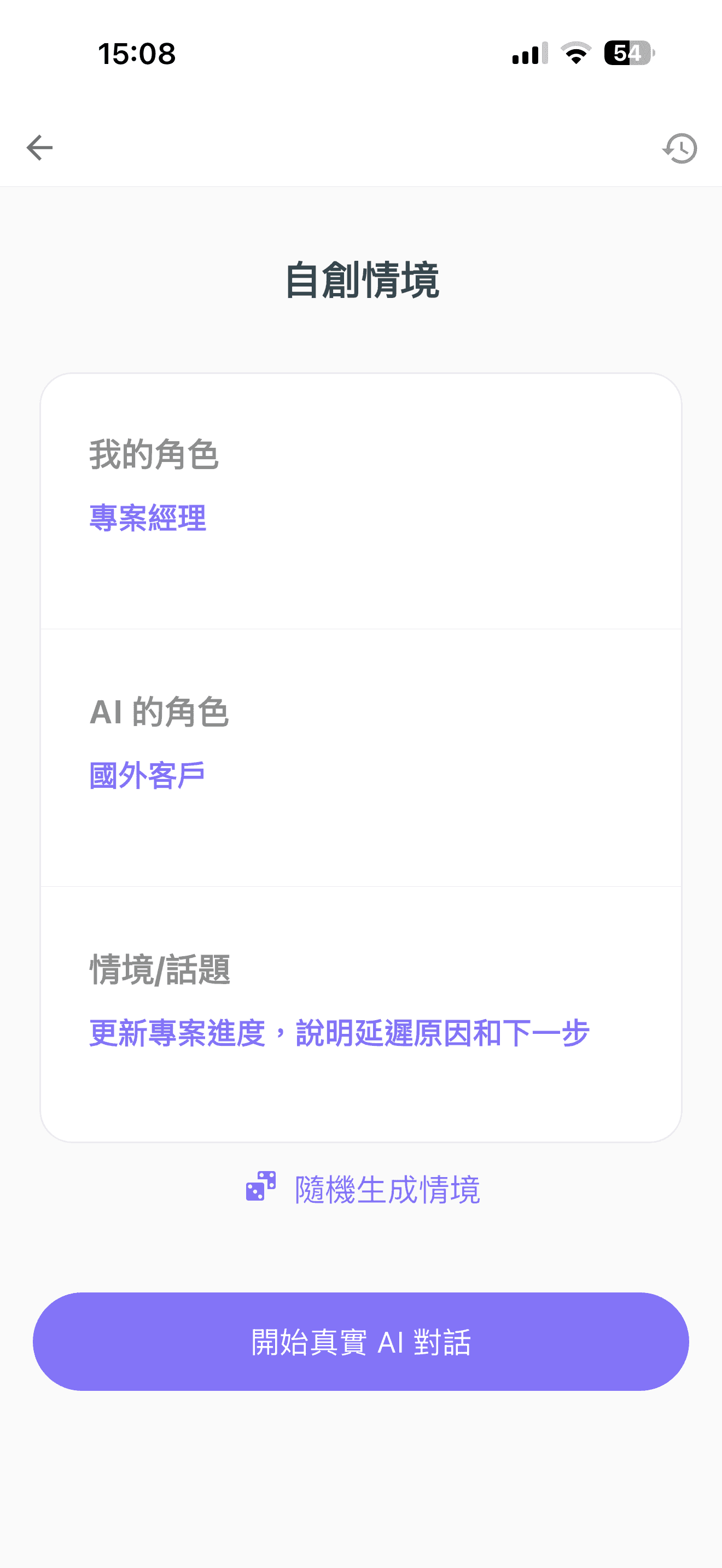 |  |
|---|---|
Intermediate employees (B1-B2): practice speaking in real work scenarios and fix grammar as they go | Advanced employees (C1 and above): turn English they can already say into more natural, native-like phrasing |
One English learning app, three levels, each getting what they need. For HR, this means there's no need to split the program into several plans just because levels differ.
Step 4: Track Everyone's Progress with One Consistent Standard
🙋🏻♀️ Which metrics show whether corporate English training is working?
Setting up the program is only the start. Whether you can show results to leadership depends on pre- and post-tests. The principle is simple: test once before training starts to record the baseline, then test again at regular intervals (for example, every quarter) with the same standard and compare the change.
With Toko, this takes almost no extra work from HR. Employees take the in-app speaking assessment regularly, five minutes each time, and the AI assigns a CEFR level. The change between two assessments is the most direct evidence of progress. Employees can also see their own vocabulary stats and unique-word counts on the Profile page, and a growth curve turns accumulated practice into something they can see, which helps keep motivation up.
There's a real case for pre- and post-testing. Chipbond, a semiconductor packaging and testing company in Taiwan, rolled out AI speaking practice and tracked results with pre- and post-assessments. Over 90% of employees showed measurable improvement in speaking, with an average of 180 minutes of practice per month.
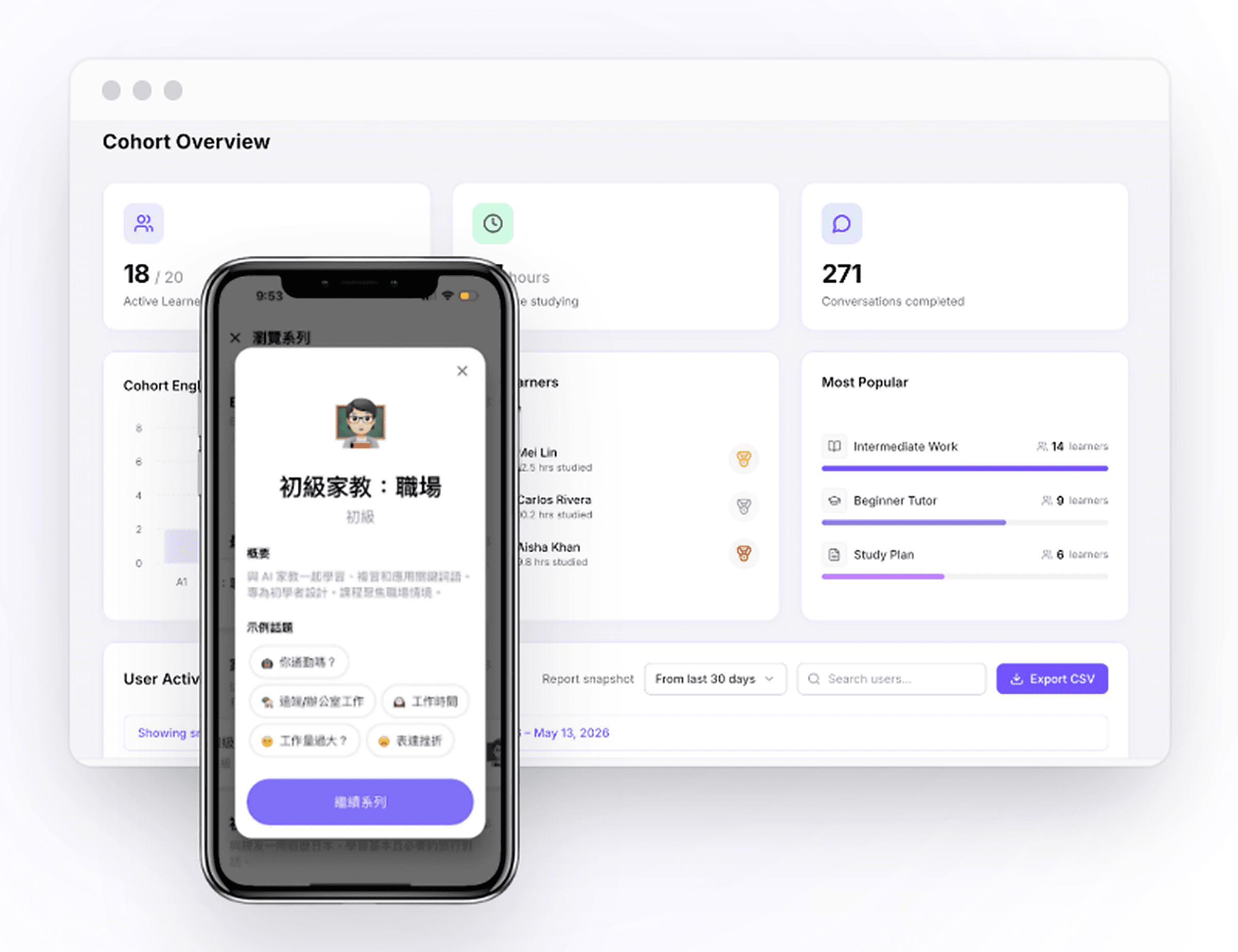
Pair this with Toko's HR admin dashboard, and you can see each employee's learning hours and usage. When you report to leadership at the end of the quarter, you bring concrete numbers on who improved and by how much, not just attendance rates and satisfaction surveys. To see what the dashboard looks like, 👉 book your free demo.
FAQ: English Assessments and Level Planning for Companies
Q1: What are the ways to test employee English levels?
There are three common options: convert existing standardized test scores (such as TOEIC), have a training provider run an assessment, or use a learning app with a built-in assessment. Note that standard TOEIC scores do not include speaking. If your training focuses on speaking, use a tool that tests it. Toko's English speaking assessment takes about five minutes, and the AI assigns a CEFR level, which makes it a practical speaking pre-test for the whole team.
Q2: How do CEFR levels map to TOEIC scores?
Based on the official ETS mapping, a TOEIC (listening and reading) score of 550 or above is roughly CEFR B1, 785 or above is roughly B2, and 945 or above is roughly C1. This mapping only reflects listening and reading. Those scores cannot stand in for speaking ability, so if your training focuses on speaking, assess speaking separately.
Q3: Our company is small. Do we still need to level employees?
Yes, and small teams need it more. With fewer people, you can't dilute level gaps by opening more classes. Skip the assessment, and you will very likely end up with A1 and B2 learners in the same room. Once levels are mapped, you can give each level its own goals and content, even without separate classes.
Q4: Do employees with strong English still need training?
It depends on the goal. Employees at B2 and above usually don't need a class. What they need is to keep speaking regularly and polish their phrasing. Giving them a self-paced practice tool, such as AI conversations with feedback on how a native speaker would say it, works far better than sitting them in a beginner or intermediate classroom, and it doesn't waste their time.
Q5: Levels vary a lot. Can one learning platform really work?
It comes down to personalization. If everyone sees the same content, it's no different from a single course. When evaluating a platform, check these things: does it assess levels, can content adjust by level and role, do beginners get word lookup and review support, and do advanced learners get deeper feedback. If an app covers assessment, adjustable content, beginner support, and advanced feedback, HR has a real chance of serving every level on one platform. Otherwise, you've just moved the same course online, and the level gap stays.
Q6: How often should we retest employee English levels?
Formal level tests don't need to be frequent. For a 3-to-6-month training cycle, test once at the start and once at the end, and check usage and assigned-task completion monthly in between. With an app-based speaking assessment that takes about five minutes, quarterly retesting also works. Just keep the test method and conditions as consistent as possible.
Want Every Employee to Start from the Right Level?
If your company also struggles with one class that can't fit everyone, 👉 book your free demo. We'll show you how personalized learning and the HR admin dashboard work together, based on your actual headcount and level distribution.
👉 Book Your Free Demo
About the author:
 | Connie Lin leads marketing content and localization at Toko. She works closely with product, QA, and user feedback, which gives her a close view of how learners actually use AI tools and where they struggle. Her work focuses on making English learning feel more natural, practical, and easier to stick with over time. |